
Introduction
The discussion of AEO vs SEO is no longer a theoretical debate. It now marks the most urgent conversation every brand owner, marketer, and startup founder must have.
Search is changing. If your brand has not changed with it, you are already falling behind.

Traditional SEO – Search Engine Optimization, focuses on getting your website to rank at the top of Google results. It has been the foundation of digital marketing for more than two decades. AEO, or Answer Engine Optimization, is newer.
It focuses on getting your brand cited inside the AI-generated answers that tools like ChatGPT, Perplexity, Google AI Overviews, and Bing Copilot now show users before any links appear.
The gap between these two approaches is widening fast.
Furthermore, companies that established AEO strategies in early 2024 captured 3.4 times more answer engine traffic than competitors who delayed, according to research by JunHammer. That gap will only grow.
This piece breaks down exactly what AEO vs SEO means, where they differ, where they overlap, and what you need to do to win on both fronts in 2026.
AEO vs SEO: Proven Differences Every Smart Brand Must Know: Table of contents
- Introduction
- AEO vs SEO: What Each Strategy Means
- The Core Differences Between AEO vs SEO
- How AEO and SEO Work Together in 2026
- AEO Strategy for Different Platforms in 2026
- How to Measure AEO vs SEO Success
- The Role of PR in Your AEO vs SEO Strategy
- Conclusion: Stop Choosing Between AEO vs SEO
- Frequently Asked Questions
AEO vs SEO: What Each Strategy Means
Before comparing AEO vs SEO directly, it helps to understand each on its own terms. Both aim to make your brand discoverable.
However, they operate on different layers of the search ecosystem.
SEO is the practice of improving your website so that search engines rank it highly for relevant keywords. It involves on-page content, technical site health, backlinks, and user experience signals.
A well-executed SEO strategy puts your pages at the top of Google’s blue-link results.
AEO- Answer Engine Optimisation is the practice of optimizing your content so that AI-powered answer engines select it when constructing direct answers to user questions.
Success in AEO is not measured by rankings or clicks. It is measured by citation frequency, how often your brand or your content appears inside the AI answer itself.
As Conductor CEO Seth Besmertnik describes it, AEO creates a parallel surface of visibility. It is an invisible layer that determines which brands are seen before anyone clicks.
Conductor’s research analyzed over 100 million AI citations across 13,770 domains to establish this framework.
Additionally, it is important to understand that AEO vs SEO is not a choice between two competing strategies.
They complement each other. A strong SEO foundation is, in most cases, a prerequisite for effective AEO, but SEO alone no longer guarantees you will be seen.
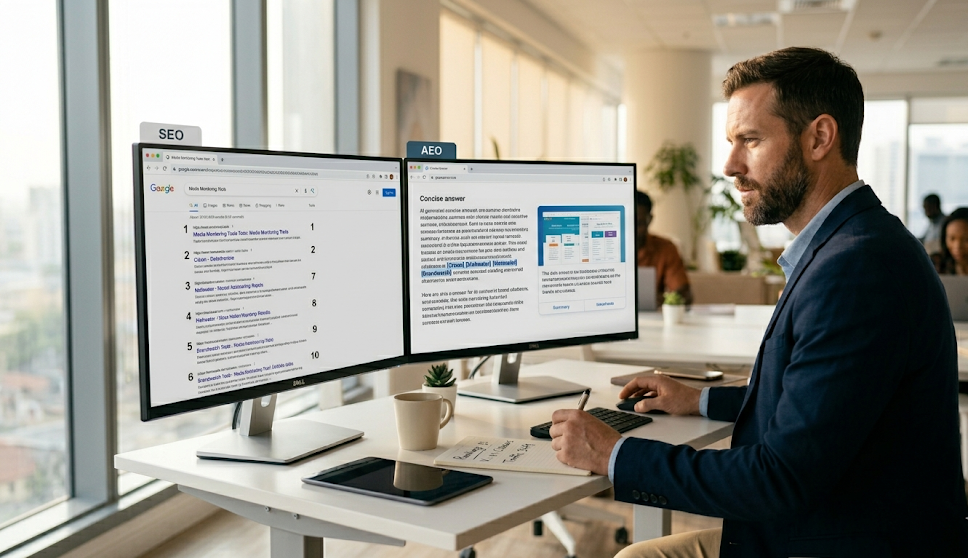
How Search Behavior Has Shifted the AEO vs SEO Debate
The AEO vs SEO conversation exists because user behavior has changed. People no longer browse.
Instead of typing short keywords and scanning results, users now type full questions into Google, ChatGPT, and Perplexity, and expect a direct answer in return.
Accordingly, Google reports that 15% of daily searches are entirely new queries, many of them long-form and conversational. Voice assistants handle millions more.
ChatGPT now serves over 800 million users weekly, according to data from early 2026. Perplexity’s user base is growing at a comparable rate.
Consequently, brands that only optimize for keywords miss the question-and-answer layer entirely.
That is where AEO vs SEO becomes a practical, not just a theoretical, problem. Y
our content might rank on page one of Google and still be invisible to the 64% of users who never scroll past the AI summary at the top.
However, there is also an opportunity here. Sources cited in AI-generated answers experience 27% higher click-through rates than traditional search placements, according to TNGShopper’s analysis.
Being cited is not just about visibility, it drives real traffic.
The Core Differences Between AEO vs SEO
Now that you understand what each strategy involves, here is a direct breakdown of how AEO vs SEO differ across the dimensions that matter most to your brand.
What They Optimize For
SEO optimizes your pages to rank in search engine results. The goal is to appear on page one, ideally in the top three positions, for target keywords.
AEO optimizes your content to be cited inside AI-generated answers.
The goal is for your brand or content to appear as the source AI tools reference when answering relevant questions.
Therefore, the unit of success is different.
In SEO, you track rankings, impressions, and organic traffic. In AEO vs SEO measurement, you also track citation frequency, how often AI tools mention your brand or pull from your content in their answers.
How They Use Keywords
Traditional SEO relies on keyword targeting. You identify the terms your audience searches for and build content around those keywords. AEO, conversely, targets questions.
You identify the specific questions your audience asks and write content that answers them directly, clearly, and concisely.
This is a meaningful shift in content strategy. Instead of writing a page titled ‘Project Management Software Features,’ you write a page that answers ‘What features should I look for in project management software?’
The latter maps directly to how people query AI tools. That is a key principle in the AEO vs SEO distinction.
How They Build Authority
Both AEO and SEO depend on authority. However, they measure it differently. SEO authority comes primarily from backlinks, the number and quality of other sites linking to yours.
AEO authority comes from what researchers call E-E-A-T signals: Experience, Expertise, Authoritativeness, and Trustworthiness. AI engines look for these signals in your content and in how your brand is mentioned across the web.
Notably, earned media plays a larger role in AEO than in traditional SEO. When Forbes or Business Insider features your brand, AI engines see that endorsement and factor it into citation decisions.
This is why PR and AEO are closely linked. A press feature in a major outlet is one of the fastest ways to accelerate AEO authority.
Technical Requirements
SEO requires solid technical foundations: fast page speed, mobile optimization, clean site architecture, and proper indexing.
AEO builds on all of these but adds an additional layer.
Specifically, structured data markup, also called schema markup, is essential for AEO. It tells AI systems exactly what your content is about, making it far easier for them to extract and use your answers.
The most useful schema types for AEO include FAQ schema, How To schema, Article schema, and Organization schema.
Additionally, AEO rewards content with clear headings, short answer paragraphs, and direct sentence structures. AI engines read differently from humans.
They scan for extractable information, not narrative flow.
How AEO and SEO Work Together in 2026
Despite their differences, AEO vs SEO is not a rivalry. The brands winning in 2026 treat them as partners in a single strategy.
Your SEO foundation gets content indexed, builds domain authority, and drives traffic.
Your AEO layer makes that content available to AI engines and earns citations in the answers your audience actually sees.
Don’t let your brand fall behind, integrate AEO and SEO now to stay visible and competitive in an AI-powered search landscape.
Start adapting your strategies today and ensure your content leads the conversation in 2026.
For example, Mentimeter’s content appeared in 124,000 ChatGPT sessions and led to more than 3,000 conversions, according to Siege Media’s 2025 analysis.
That result came from a strategy that combined strong SEO foundations with AEO-optimized content formats.
Their pages ranked well in traditional search. They were also structured to be cited by AI engines. That combination is what you need.
Furthermore, Google’s own AI Overviews are tightly coupled with traditional Google indexing.
If your SEO is weak, your AEO results will suffer too. This reinforces why you cannot choose one over the other. You need both running in parallel.
Related: GEO Secrets: Smart Tactics to Boost Visibility Now
Building a Content Strategy That Serves Both AEO and SEO
Here is how to create content that performs well across both AEO and SEO dimensions simultaneously:
- Start with questions your audience actually asks. Use Google’s People Also Ask, AnswerThePublic, or Perplexity’s autocomplete to find real queries.
- Write a direct answer to each question in the first 50 to 100 words of each section. Do not bury the answer. AI engines scan for it at the top.
- Use clear H2 and H3 headings that mirror the question format. This signals structure to both Google and AI engines.
- Add an FAQ section to every article. Mark it up with the FAQ schema. This is one of the highest-ROI tactics in the AEO vs SEO strategy.
- Include original data, statistics, and expert quotes. AI engines strongly favor content with citable, verifiable information.
- Update content regularly. Brands leading in AEO update their key pages at least quarterly, according to Evergreen Media’s 2026 AEO guide.
AEO Strategy for Different Platforms in 2026
An important nuance in AEO vs SEO is that AEO is not one-size-fits-all. Different AI platforms have different preferences for what they cite.
Optimizing for Google AI Overviews
Google AI Overviews are tightly connected to Google’s traditional index. Therefore, strong traditional SEO is the entry requirement. If Google already ranks you well, your chances of appearing in its AI Overview improve significantly.
Additionally, structured data and FAQ pages give Google clear signals to pull from. Focus on concise, fact-rich answers at the top of each content section.
Optimizing for ChatGPT Citations
ChatGPT now has 489 million unique monthly visitors, according to data from August 2025 published in Conductor’s AEO research.
It is the dominant AI search platform. Early adopters of GEO-ready content are being discovered up to 10 times faster by ChatGPT, according to the GEO Industry Report 2025.
For ChatGPT, original research, named expert attribution, and high-authority backlinks all drive citation frequency. A press feature in Forbes, for instance, directly boosts your visibility in ChatGPT answers about your topic.
Optimizing for Perplexity
Perplexity behaves differently. According to Evergreen Media’s 2026 AEO guide, Reddit dominates Perplexity’s source citations at 46.7% of top-10 results, followed by YouTube at 13.9%.
Therefore, your Perplexity AEO strategy should include building a presence on Reddit and Quora, engaging in community discussions, and creating video content.
Genuine, helpful answers in community spaces carry more weight on Perplexity than polished branded content.
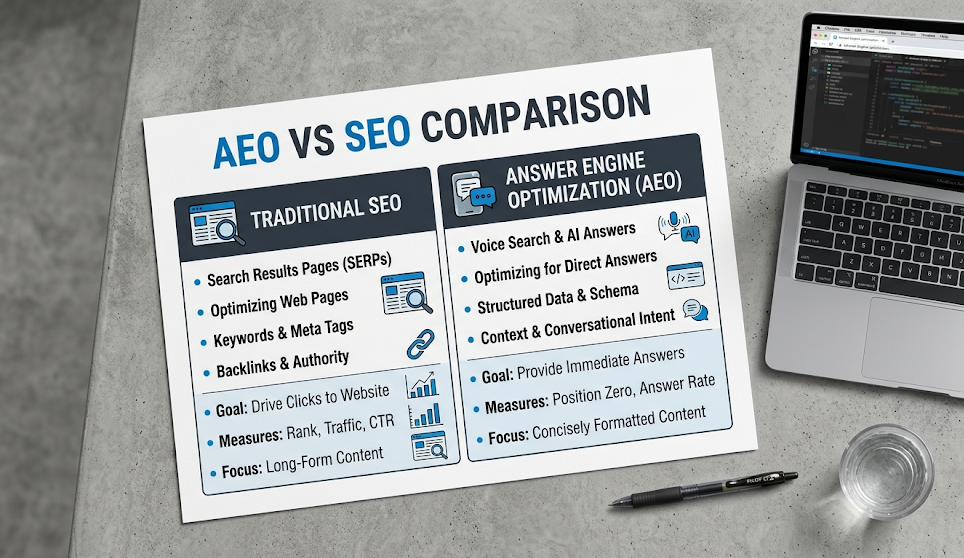
How to Measure AEO vs SEO Success
Tracking AEO progress requires different metrics than traditional SEO.
However, many AEO signals build on existing SEO data. Here is what to track across both dimensions:
- Organic rankings and traffic – your baseline SEO performance across target keywords
- AI citation frequency – how often your brand appears in AI-generated answers to target questions
- Featured snippet presence – tracked via Semrush, Ahrefs, or Moz, these are early AEO signals.
- Branded search volume -as AI citations increase, direct brand searches typically grow too
- Referral traffic from AI platforms – track ChatGPT, Perplexity, and Google AI Overview in your analytics
- Domain rating and referring domains – authority metrics that underpin both SEO and AEO performance
Additionally, test your AEO performance manually. Ask ChatGPT and Perplexity the questions your audience asks. Note whether your brand appears.
If it does not yet, you know exactly where to focus your content and media efforts next.
Moreover, 36.4% of content marketers reported a drop in website traffic between 2024 and 2025 as AI tools became mainstream, according to Siege Media.
This data confirms that passive reliance on SEO alone is no longer sufficient. Your brand needs both strategies running together.
The Role of PR in Your AEO vs SEO Strategy
One aspect of AEO vs SEO that many brands overlook is the role of earned media. Both strategies benefit from press coverage. But AEO benefits even more directly.
AI engines cite authoritative sources. The most authoritative sources online are high-domain publications: Forbes, Bloomberg, Business Insider, Entrepreneur, and similar outlets.
When your brand earns consistent coverage in these publications, AI engines treat your brand as an authority on the topics those articles cover.
Consequently, PR is not just a brand-building exercise. It is a direct input into your AEO performance. Each press feature creates an indexed, authoritative page that mentions your brand in context.
Over time, those pages teach AI engines who you are and what you know. That translates into citations.
Therefore, the smartest brands in 2026 run their SEO, AEO, and PR strategies as a connected system. Content builds topical authority.
PR builds external credibility. Schema markup makes that content machine-readable.
All three together create the kind of omnipresent brand visibility that AEO vs SEO demands.
Conclusion: Stop Choosing Between AEO vs SEO
The AEO vs SEO debate is real. But the answer is not one or the other. It is both. Your brand needs to show up in Google’s blue links, in its AI Overviews, in ChatGPT answers, and in Perplexity citations.
These are not separate battlegrounds. They are different surfaces of the same audience.
Start with your SEO foundation. Make sure your content is indexed, structured, and built around the questions your audience is asking.
Then add the AEO layer: FAQ sections, schema markup, direct answers near the top of every section, and consistent press coverage in high-authority publications.
Afterward, track both. Measure your rankings and your AI citations. Watch where your audience finds you and where they do not. Adjust accordingly.
The brands that understand AEO vs SEO as a combined strategy not a binary choice, are the ones that will own search visibility in 2026 and beyond.
The window to build this advantage is open right now. Do not leave it for your competitors to claim.
Frequently Asked Questions
What is the main difference between AEO and SEO?
SEO focuses on ranking your website pages in traditional search engine results. AEO focuses on getting your content cited inside AI-generated answers on platforms like ChatGPT, Perplexity, and Google AI Overviews. Both aim for visibility but operate on different layers of the search ecosystem.
Do I need AEO if my SEO is already strong?
Yes. Strong SEO helps, but it does not guarantee AI citation. In 2024, 64% of US searches never resulted in a click to any website. AI-generated summaries are capturing that traffic. Without AEO, you are invisible to a large and growing share of your audience, even if your SEO rankings are excellent.
How do I start with the AEO strategy?
Start by identifying the specific questions your audience asks. Write content that answers those questions directly in the first 50 to 100 words of each section. Add FAQ schema markup to your pages. Earn press coverage in high-authority publications. Then test your visibility by asking relevant questions directly to ChatGPT and Perplexity.
How long does AEO take to show results?
Most brands see early AEO results within three to six months of consistent effort. However, meaningful and stable citation frequency builds over six to twelve months. The more authoritative your content and your earned media coverage, the faster you progress. Patience and consistency are both required.
Is GEO the same as AEO?
They are closely related but not identical. AEO is the practice of optimizing for AI-powered answer engines broadly. GEO, or Generative Engine Optimization, specifically focuses on large language models and generative AI platforms. In practice, most AEO strategies include GEO principles. The terms are often used interchangeably, though AEO is the wider umbrella.
