
There was no press release, no official transition, just a quiet shift driven by a GEO Content strategy.
One quarter, your traffic metrics looked familiar. The next day, impressions were steady, but clicks had gone quiet.

If you’ve been in digital marketing long enough, you’ve seen this pattern before. But this time, the rules didn’t just shift.
They were replaced.
As a result, Google’s blue links, the currency of a decade’s worth of SEO effort, no longer represent the end goal for most search journeys.
People want answers, not lists of pages that might contain answers. ChatGPT gives them one. Perplexity gives them one.
Google’s own AI Overviews gives them one. And in that single synthesized response, your brand either gets a mention or it doesn’t.
That’s what a GEO content strategy is really about: earning your place in the answer, not just the index.
GEO Content Strategy: Proven Framework to Win Search in 2026: Table of contents
- What Is a GEO Content Strategy, and Why Does It Replace Traditional SEO Thinking?
- How Generative Engines Actually Decide What to Surface
- AI-First GEO Content strategy Marketing Isn’t a Trend; It’s a Structural Advantage
- The Four Principles Behind a GEO Content Strategy That Holds Up
- Human Trust as a Ranking Signal
- Building a Generative Search GEO Content Strategy That Actually Works
- The Role of Digital PR in Strengthening Your GEO Content Strategy
- Common Mistakes That Undermine a GEO Content Strategy
- Measuring the Success of Your GEO Content Strategy
- What Successful Brands Are Doing Differently With Their GEO Content Strategy
- Conclusion: Build Your GEO Content Strategy for the AI-First Future
What Is a GEO Content Strategy, and Why Does It Replace Traditional SEO Thinking?
GEO Generative Engine Optimization isn’t a rebrand of SEO with a trendier acronym.
Instead, it’s a fundamentally different set of priorities.
Traditional SEO was built around a specific behavior: someone types a query, a ranked list appears, and they click something.
The whole game was positioning; get high enough on the page, and traffic follows.
A GEO content strategy, however, operates on different logic entirely. Generative AI doesn’t serve a ranked list.
It writes a response. And to write that response, it pulls from sources it trusts, understands, and can extract meaning from cleanly.
That means the content requirements are different.
Semantic clarity matters more than keyword density; an AI system needs to understand what your piece is about, not just what words appear in it frequently.
Structural formatting matters because machines parse content in layers; a well-organized article with clear headings and logical sections is far easier to extract than a wall of prose.
Authority signals matter because AI systems, like good editors, have learned to be skeptical of sources that lack verifiable expertise.
And citation readiness matters because content that can be pulled cleanly into a response is content that gets pulled.
Consequently, brands that have started building around these priorities are already seeing the gap widen between themselves and competitors who haven’t.
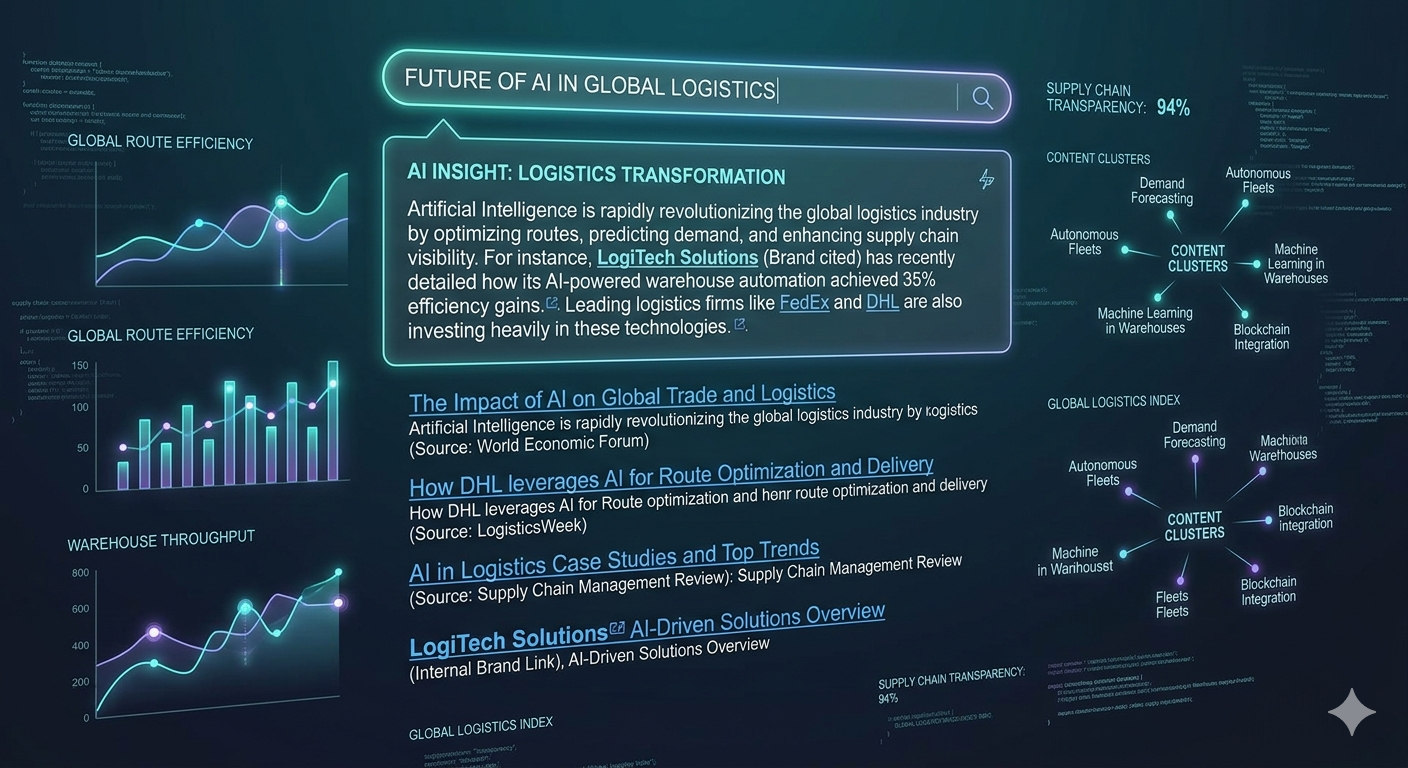
How Generative Engines Actually Decide What to Surface
To understand why a GEO content strategy works, it helps to spend a moment with the machinery behind it.
When someone asks an AI assistant a question, two systems kick in almost simultaneously.
The first is a retrieval system; it scans indexed content looking for sources that match the intent of the question.
Rather, it’s not doing a simple keyword match.
It’s evaluating semantic relevance (Does this piece actually address what the user needs?), structural clarity,
(Is this content laid out in a way that’s easy to process?) and authority signals (Does this source have a track record of accuracy and credibility?).
The second system is the generation layer.
It takes what the retrieval system found, plus whatever the model already knows from pre-training, and synthesizes an answer.
Furthermore, it heavily favors content that’s consistent, well-reasoned, and clearly organized.
Vague claims, contradictory information, and murky structure all become liabilities at this stage.
The GEO framework 2026 is built on a simple but important distinction from traditional search: these systems are not ranking pages.
They are composing responses.
As a result, the content that feeds those responses needs to be written with that in mind, not to impress an algorithm, but to be genuinely useful as a source.
That’s a subtle shift in intent, but it produces very different content.

AI-First GEO Content strategy Marketing Isn’t a Trend; It’s a Structural Advantage
There’s a version of this story where brands wake up to GEO principles in a year or two, scramble to catch up, and things more or less even out.
That’s probably not how it plays out.
The brands currently committed to AI-first content marketing are doing something that compounds.
Every piece of credible, well-structured, entity-rich content they publish makes their broader body of work more recognizable to AI systems.
As a result, their topical authority deepens. Their citation frequency grows.
When someone asks an AI assistant about their industry, these brands are the ones whose names appear in the response, not because they paid for placement but because they built for it.
Traditional content approaches, high-volume output, thin coverage of broad topics, and keyword stuffing dressed up as articles don’t just fail to help in this environment.
In fact, they actively signal low authority.
An AI system that has indexed thousands of sources learns quickly which ones add value to a response and which ones don’t.
What AI-first content marketing actually looks like in practice is more disciplined than it sounds. It means choosing fewer topics and covering them more completely.
Additionally, this also means owning a subject area rather than skimming across twenty of them.
It means structuring every piece so that a machine and a human can navigate it without effort. And it means treating accuracy as infrastructure, not a finishing touch.
Read More : GEO Secrets: Smart Tactics to Boost Visibility Now
The Four Principles Behind a GEO Content Strategy That Holds Up
Strip away the jargon, and a working GEO content strategy rests on four things. Get these right, and the technical details largely take care of themselves.
Context Over Keywords
This one requires unlearning something.
For years, keyword placement was the primary lever marketers pulled.
Put the right phrase in the right density in the right spots, and rankings followed.
That logic hasn’t entirely disappeared, but it’s no longer the backbone. Instead, what AI systems reward is meaning.
A piece that fully explains a concept and that maps out the relationships between ideas addresses the follow-up questions a reader would naturally have.
Additionally, this doesn’t leave gaps in the reasoning and performs better than one that hits a keyword quota.
Write for understanding first.
The keywords are still there; they’re just embedded in something worth reading.
Authority Over Volume
One genuinely authoritative article is worth more than ten forgettable ones.
That’s not a new idea in journalism; it’s how good publications have always thought.
But it’s new in content marketing, where volume has long been treated as a proxy for quality. AI systems have effectively forced the correction.
Specifically, they don’t reward publishing schedules. They reward depth, precision, and evidence.
If your GEO content strategy is still measured primarily in pieces per month, that’s the first metric worth reconsidering.
Structured Clarity for Machine Readability
There’s nothing counterintuitive here.
AI systems process content systematically; they look for signals that indicate what a piece is about and how it’s organized.
Clear H2 and H3 headings, logical section breaks, bullet points used purposefully rather than decoratively, and short paragraphs that make one point before moving to the next.
These aren’t stylistic choices. Rather, they’re functional ones.
The fortunate side effect is that this kind of structure also makes content more readable for humans.
A well-organized article that machines can parse easily is almost always a better-written article.
Human Trust as a Ranking Signal
AI systems have become reasonably good at identifying trustworthy content.
They look for factual consistency across a body of work, proper attribution of claims and data, and clear sourcing.
A brand that regularly publishes accurate, well-cited content builds a kind of credibility profile that AI systems register over time.
The inverse is also true.
Outdated statistics, unattributed claims, and factual inconsistencies, the kinds of things that slip through when content is produced at volume without rigorous editorial oversight, erode that credibility in ways that are hard to recover from.
Building a Generative Search GEO Content Strategy That Actually Works
A generative search content plan is where GEO strategy becomes execution. It defines what you publish, how you structure it, and how you sustain it.
Here’s how to build one that holds up.
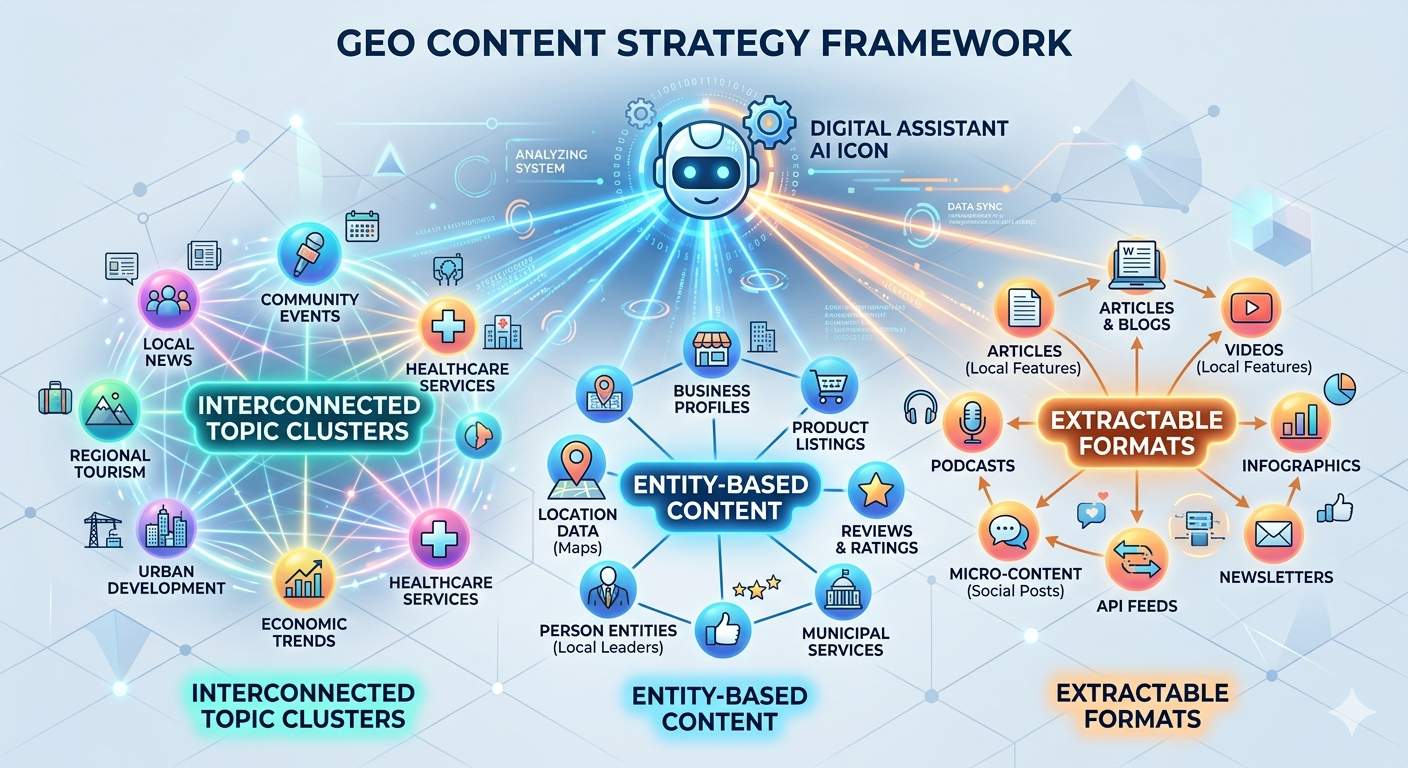
Step 1: Define Your Topic Clusters
Topic clusters are the organizing architecture of a GEO content strategy.
Rather than publishing standalone pieces on loosely related subjects, you build interconnected groups of content around specific themes.
This serves as a central pillar piece supported by more specific articles that go deeper on particular aspects.
When AI systems encounter a well-built topic cluster, they recognize the depth and coherence of your expertise in that area.
In other words, it’s the content equivalent of having a genuine specialization rather than a general interest.
Step 2: Build Entity-Based Content
Entities, specific people, organizations, concepts, products, and defined terms, are how AI systems build context around content.
A piece that clearly establishes what it’s about, in entity terms, is easier for a generative engine to slot into a response accurately.
This means being precise.
Don’t gesture at ideas; name them.
Define the concepts you’re working with.
Connect them explicitly to the entities they belong to.
The more clearly your content maps onto a structured understanding of the world, the more useful it becomes as a source.
Step 3: Lead With Extractable Formats
Not all content formats serve a GEO content strategy equally.
For instance, explainers and definitions are particularly valuable; they give AI systems clean, citable answers to specific questions.
Original research and data-backed insights raise citation likelihood significantly, since AI systems have limited access to proprietary information and will reference credible original sources when they exist.
Step-by-step guides are highly extractable by design.
FAQs, moreover, map directly onto conversational query patterns, which makes them naturally suited to how people interact with AI assistants.
If your existing content is heavy on narrative and light on structured answers, adding these formats is one of the faster wins available to you.
Step 4: Treat Factual Accuracy as Maintenance, Not a One-Time Job
Outdated information is a credibility liability that accumulates quietly.
For example, a statistic that was accurate in 2022 may actively mislead today.
An AI system that indexes your content and finds internal inconsistencies, or contradictions with more recent sources, learns to trust your material less.
Regular content audits aren’t exciting work, but they’re load-bearing.
Therefore, build them into your editorial calendar on a set schedule, with particular attention to anything involving statistics, policy, or fast-moving subject matter.
Step 5: Play the Long Game on Consistency
Visibility in generative search is not a campaign outcome. It’s an infrastructure outcome.
The brands that show up consistently in AI-generated responses got there by publishing consistently good content over time, not by producing a flurry of activity and then going quiet.
Set a publishing rhythm you can genuinely sustain. Stick to it. Let the body of work accumulate.
Ultimately, that accumulation, not any single piece, is what builds the kind of authority that AI systems recognize and return to.
The Role of Digital PR in Strengthening Your GEO Content Strategy
This is how PR helps fuel your GEO content strategy:
- More likelihood of your brand information appearing in AI training data and/or retrieval systems
- More likelihood of your brand information appearing in AI training data and/or retrieval systems
- Consistency of message in PR, articles, and other content helps build trust with AI systems, which value consistency
Additionally, by using a similar message in your PR and GEO content strategy, you are creating a multiplier effect. This will help increase your brand’s visibility in front of AI systems.
Common Mistakes That Undermine a GEO Content Strategy
Many brands are investing in a content strategy, yet still, they are not getting visibility in front of AI systems.
This is most likely due to one of these critical mistakes.
Mistake 1: Over-Optimising for Keywords
A GEO content strategy is not an SEO strategy with a different name.
Keyword stuffing also makes the content less coherent and more difficult to interpret for AI systems.
Therefore, prioritize meaning over optimization.
Mistake 2: Publishing High Volume, Low Authority Content
Publishing a lot of content, no matter how low its authority, will be viewed unfavorably by AI systems.
They will always prefer fewer, more authoritative pieces of content.
Therefore, a GEO content strategy will be weakened if a brand prioritizes quantity over quality.
Mistake 3: Ignoring Factual Accuracy
AI systems reject inaccurate information as untrustworthy
Therefore, a GEO content strategy must prioritize accuracy above all.
Mistake 4: Treating AI Like a Search Engine
AI systems answer questions, not rank web pages.
.Therefore, brands must design their GEO content strategy with citation and inclusion in mind, not just visibility on a results page.
Measuring the Success of Your GEO Content Strategy
The traditional analytics tools were not designed for use in GEO.
However, there are some significant aspects of tracking the performance of your content strategy in GEO.
Some of the key aspects of performance in GEO:
- The appearance of your brand in the answers provided by AI for specific queries.
- The frequency of your brand citation in the answers provided by AI for specific queries.
- The share of voice for your brand in the platforms that use generative technology.
- The extractability of your content in the answers provided by AI for specific queries.
It is also significant to monitor your brand’s appearance in credible publications.
An increase in credible publications often corresponds to an increase in your brand’s appearance in AI.
Thus, it is significant to view PR analytics and content analytics as two different data streams for your content strategy in GEO.
What Successful Brands Are Doing Differently With Their GEO Content Strategy
The brands winning in AI-generated search share several consistent behaviors.
Their GEO content strategy is not a campaign; it is an ongoing operating model.
Investing in Original Insights
Unique data, proprietary research, and original perspectives increase the likelihood of citation.
AI systems favor content that offers something they cannot find elsewhere.
Therefore, original thought leadership is a central pillar of effective GEO content strategy.
Integrating PR, Content, and Data Strategy
The most effective GEO content strategy integrates PR, content marketing, and data into a unified approach.
This alignment improves consistency, amplifies authority signals, and ensures that messaging is coherent across every channel.
Building Long-Term Authority
Sustainable GEO visibility does not happen overnight.
Additionally, it cannot be manufactured with shortcuts.
Brands that succeed invest in credibility over time, publishing consistently, maintaining accuracy, and building genuine expertise across their chosen topics.

Conclusion: Build Your GEO Content Strategy for the AI-First Future
The shift to generative search is not coming; it is here.
Therefore, brands that act now will build the authority, trust, and visibility that AI systems require before competitors catch up.
A strong GEO content strategy demands clarity over cleverness, authority over volume, and consistency over shortcuts.
Furthermore, it requires integrating content, PR, and data into a unified approach designed for machine interpretation as much as human engagement.
The GEO framework 2026 makes one thing clear: brands that are understood, trusted, and consistently cited by AI systems will define the next era of digital visibility.
Additionally, AI-first content marketing is not a trend; it is the new standard for sustainable brand growth. Your generative search content plan starts today.
Define your topic clusters. Build extractable, authoritative content.
Align your PR narratives. Measure AI visibility, not just rankings.
Moreover, invest in credibility as a long-term asset, not a short-term campaign.
The brands that win in an AI-first world are the ones that build content worth citing. Therefore, start building yours now.